
how to tell a rooster from a hen,If you’ve ever peered into a brooder full of fluffy chicks and wondered which ones will grow up crowing and which will start laying eggs, you’re in good company. Sexing chickens is one of the most common puzzles new flock owners face and for good reason. Unless you’ve hatched a special sex-link hybrid, most chicks give away almost nothing about their future selves on the first day of life. The truth is, telling a rooster from a hen isn’t about spotting one magic sign.
It’s about watching a handful of physical and behavioral clues unfold gradually, from comb color in the first few weeks to that unmistakable first crow months later.
This guide walks through every stage of that process, from hatch-day science used by professional sexers to the definitive markers that show up once your bird reaches maturity so you’ll know exactly what to look for, and when.
Sexing Methods at Hatch (Day 1)
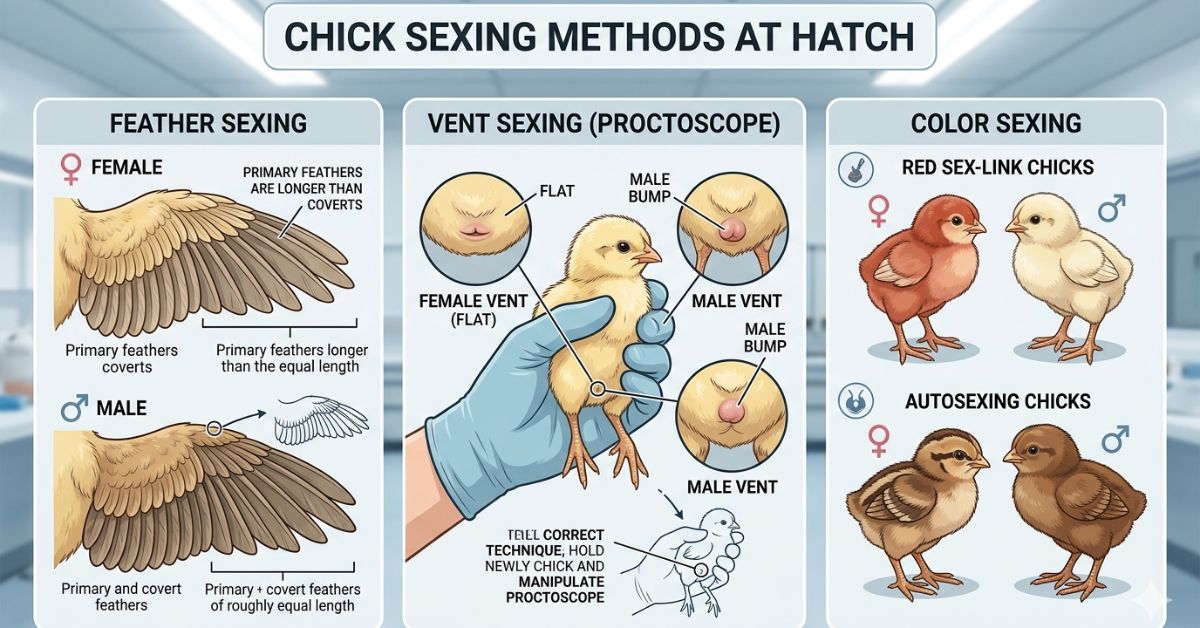
For hatcheries and breeders who need to know a chick’s sex immediately, a few specialized techniques make it possible though none are easy for the average backyard keeper to replicate.how to tell a rooster from a hen
Vent sexing is the oldest and most widely used professional method. A trained sexer examines subtle differences in the chick’s cloacal anatomy within hours of hatching. Done correctly, it’s highly accurate, but it takes months of practice to master and carries real risk of injuring the chick if attempted by an untrained hand; this is not a DIY project.
Feather sexing relies on genetics rather than anatomy. In certain breeding lines, males and females are bred so their wing feathers grow at visibly different rates. By comparing the length of primary flight feathers to covert feathers on the same wing, a keeper can make an educated call within a day or two of hatching. how to tell a rooster from a hen
Color sexing, also known as sex-linking, is the most accessible method for hobbyists. Crosses like the Black Star, Red Star, and Golden Comet are bred specifically so male and female chicks hatch in different, easily distinguishable colors with no anatomical expertise required.
The catch with all three methods: they only work on chicks bred or hatched under controlled conditions. If you’re raising heritage breeds, mixed flocks, or chicks from a broody hen of unknown parentage, none of these hatch-day shortcuts apply, meaning most keepers are left waiting for the visual and behavioral clues covered next. how to tell a rooster from a hen
Early Clues (Weeks 1–6)
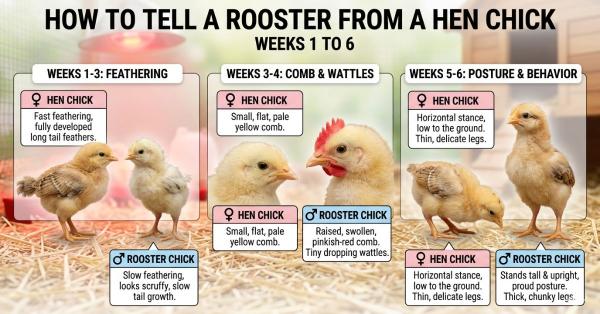
Once chicks are past their first few days, the earliest visible clues start to emerge though at this stage, patience is still essential, since signs can be subtle and easy to misread.
The most useful early indicator is comb and wattle development. By around 4 to 6 weeks, chicks that will grow into roosters typically show combs and wattles that are noticeably larger, redder, and more developed than their flock mates. Hens’ combs stay smaller, paler, and grow in more gradually, often not turning fully red until much closer to laying age.
Growth rate and body size also begin to diverge during this window. Future roosters often put on size faster and can appear taller or more solidly built compared to pullets of the same age and breed. how to tell a rooster from a hen
Behaviorally, this is when the first hints of a pecking order start to show. Chicks that will become roosters often display more boldness, curiosity, and assertiveness nudging into food first, exploring further from the group, or standing their ground during minor scuffles.
That said, this stage is notorious for false calls. A large comb on one chick doesn’t guarantee a rooster, and a bold personality doesn’t rule out when individual variation within breeds is high, and stress, diet, and genetics can all affect development speed. The safest approach at 6 weeks is to note early impressions but hold off on firm conclusions until more markers appear in the coming weeks.
Mid-Stage Development (Weeks 6–12)
By 6 to 12 weeks, the clues become harder to ignore, and side-by-side comparisons within a flock start to tell a much clearer story.
Comb and wattle growth accelerates noticeably in this window. Future roosters often show combs that are not just larger but thicker and more vividly red, while hens’ combs remain comparatively flat, pale pink, and slow-growing. Lining chicks up next to each other makes the contrast easier to spot than judging any single bird alone.
Leg thickness becomes another useful marker. Roosters tend to develop noticeably sturdier legs, and by the later part of this stage, small bumps may appear on the back of the leg the earliest sign of spurs beginning to form. Hens’ legs stay comparatively slim and smooth.
Posture shifts are also worth watching. Roosters increasingly carry themselves upright, with a more alert, chest-forward stance, while hens tend to hold a flatter, more horizontal posture suited to foraging. how to tell a rooster from a hen
Perhaps the most exciting and unmistakable development in this stage is feather shape divergence. Hackle feathers (around the neck) and early tail feathers begin to take on a pointed, almost spiky look in roosters, contrasting with the rounder, blunter feather edges hens keep.
Finally, many keepers get their first surprise around this age: early crowing attempts. These initial crows are often cracked, squeaky, or incomplete closer to a comedic warm-up than the confident call a mature rooster will eventually produce but they’re a strong and fairly reliable signal once they start.
Definitive Adult Markers (Weeks 12–20+)
By the time chicks reach 12 to 20 weeks, guesswork gives way to certainty. This is the stage where nearly every physical and behavioral trait lines up to confirm what earlier clues only hinted at.
The clearest sign is the appearance of saddle feathers and pointed hackles. Roosters grow long, narrow, pointed feathers just in front of the tail (saddle feathers) and along the neck (hackles), often with a glossy sheen. Hens never develop this feature, making it one of the single most reliable markers in the entire process.
Closely related are sickle feathers the long, dramatically curved tail feathers that sweep upward and outward, giving mature roosters their iconic silhouette. Hens’ tails stay shorter, straighter, and more fan-shaped by comparison.
Combs and wattles reach their full size and color by this stage, with roosters showing large, deep-red, prominent growths, while hens’ remain noticeably smaller and softer in color, even as they approach laying age.
Spurs are now unmistakable in roosters, hardening into pointed, keratinized growths on the back of the leg. True spurs rarely appear on hens, and if they do, they stay small and blunt.
Vocally, crowing becomes confident and consistent, no longer cracked or hesitant. Physically, roosters show clear gains in body mass and musculature, with a broader chest, more upright carriage, and overall larger silhouette compared to hens of the same age and breed.
Taken together, these traits leave little room for doubt.
Behavioral Differences Beyond Crowing
While crowing gets the most attention, roosters and hens diverge in several other behaviors that are just as telling once you know what to watch for.
Protective and guarding behavior is one of the clearest rooster traits. Mature roosters often position themselves at the edge of the flock, scanning for threats, and will sound sharp alarm calls when predators or unfamiliar movement appear overhead or nearby. Many also physically place themselves between perceived danger and the rest of the flock.
Dominance displays are another strong indicator. Roosters frequently perform a behavior called wing-dropping, dragging one wing along the ground while circling a hen or a rival as part of courtship or establishing pecking order. Sparring, chest-bumping, and brief flurries with other young males are also common as roosters test their status within the flock.
Mating behavior itself becomes evident by this stage too, with roosters actively courting hens through circling, clucking invitations, and mounting behavior.
On the hen side, several behaviors point clearly in the opposite direction. Nesting instincts emerge as hens approach laying age, including investigating nest boxes and rearranging bedding. Broodiness when settling persistently on eggs, even unfertilized ones, and growling or puffing up when disturbed is an exclusively female behavior. Many keepers also notice the distinctive egg song, a loud, repetitive cackling hens perform after laying, which roosters never replicate.
Together, these behaviors round out a full picture that complements the physical markers already covered.
Breed-Specific Considerations
Not all breeds play by the same rules, and knowing which ones complicate the process or simplify it can save a lot of guesswork.
Notoriously difficult breeds top the list of frustrations for many keepers. Silkies are a classic example: their fluffy, non-differentiated plumage means the usual feather-shape clues (pointed hackles, sickle tail feathers) are far less pronounced or take much longer to appear, sometimes leaving keepers unsure until 6 months or later. Polish chickens present a similar challenge, since their prominent head crests can obscure comb development, one of the earliest and most reliable markers in standard breeds. Breeds with naturally small combs, like Chanteclers, also make this particular clue less useful.
On the other end of the spectrum, breeds with early, obvious markers make sexing much more straightforward. Many standard dual-purpose breeds, such as Rhode Island Reds or Plymouth Rocks, show clear comb and wattle differences by 6 to 8 weeks, and their feather shape divergence tends to follow a predictable timeline.
Physical breed traits add another layer of complexity. Feathered-leg breeds, like Cochins or Brahmas, can make spur development harder to spot early on, since developing spurs are partially hidden by leg feathering. Crested breeds face the comb-visibility issue already mentioned, and breeds with unusual comb types, such as rose combs or pea combs, may develop differently than the standard single comb most sexing guides describe.
Common Mistakes and Myths
Even experienced keepers fall for a few persistent myths when sexing chickens. Clearing these up can prevent costly misidentifications.
Myth: Comb size alone is definitive. While comb development is one of the earliest and most useful clues, relying on it in isolation is a common trap. Individual variation, breed differences, and even diet can affect comb growth rate, causing some hens to develop noticeably early or some roosters to lag behind. Comb size should always be weighed alongside other markers, not treated as a standalone verdict.
Myth: Only roosters crow. This one catches many keepers off guard. While far less common, hens are fully capable of crowing, particularly in flocks without a rooster present or where a hen has taken on a more dominant role. A crowing hen doesn’t necessarily indicate a sex-identification error; it simply means crowing alone isn’t a foolproof test.
Myth: Color always indicates sex. This misconception often comes from sex-link breeds, where hatch color reliably predicts sex. But this only applies to specific hybrid crosses bred intentionally for that trait. In heritage breeds, mixed flocks, or chicks from a broody hen, color has no connection to sex whatsoever, and assuming otherwise leads to frequent misidentification.
The broader lesson across all three myths is the same: no single trait tells the whole story. Roosters and hens are best identified by looking for a cluster of consistent physical and behavioral rather than betting everything on one shortcut.
Decision Checklist / Quick Reference
With so many markers spread across different ages, it helps to have them all in one place. Use this checklist alongside your bird’s approximate age to narrow down a verdict.
Weeks 1–6 (early signs, low confidence):
- Comb/wattle slightly larger and redder than flock mates
- Faster growth rate or larger body size
- Bolder, more assertive behavior at the feeder
Weeks 6–12 (moderate confidence):
- Comb and wattle clearly thicker and more vividly red
- Legs noticeably thicker; small spur bumps may appear
- More upright, chest-forward posture
- Hackle and tail feathers starting to look pointed rather than round
- Cracked or squeaky early crowing attempts
😘Weeks 12–20+ (high confidence):
- Pointed saddle feathers present in front of the tail (hens never grow these)
- Long, curved sickle feathers in the tail
- Full-sized, deep-red comb and wattles
- Hardened, pointed spurs on the legs
- Confident, consistent crowing
- Broader chest and visibly larger, more muscular frame
Behavioral cluster (any age, but clearer over time):
- Guarding, alarm-calling, wing-dropping, and sparring point to rooster
- Nesting behavior, broodiness, and the egg song point to hen
The rule of thumb: the more boxes checked in a single column, the more confident the call. One or two isolated traits especially before 12 weeks aren’t enough on their own. But once saddle feathers, spurs, and confident crowing all show up together, there’s no longer any real doubt.
What to Do Once You Know
Confirming your bird’s sex is only the first step; what comes next depends on whether you’ve ended up with a rooster or a hen.
If you have a rooster, the first thing to check is local regulations. Many cities and suburban neighborhoods restrict or outright ban roosters due to noise, even where hens are permitted, so it’s worth confirming your zoning rules before getting attached. Flock ratio also matters: too many roosters relative to hens (generally more than one rooster per 8–10 hens) can lead to over-mating, stress, and fighting among males. If you can’t keep him, options include rehoming through local poultry groups, farm swap pages, or livestock auctions, giving him to someone with acreage who wants a flock guardian, or, for those raising meat birds, processing him for the table.
If you have a hen, the good news is much simpler: it’s mostly a matter of patience. Most breeds begin laying between 18 and 22 weeks of age, though this varies by breed, season, and daylight hours. In the run-up to laying, watch for nesting behavior like investigating nest boxes, and make sure boxes are set up and ready. Diet matters too, switching to a layer feed with adequate calcium around this age supports strong eggshell development. Beyond that, hens generally settle into flock life with minimal fuss, making the wait for that first egg the main thing left to look forward to.
Conclusion
Telling a rooster from a hen isn’t a matter of spotting one magic sign, it’s about learning to read a whole cluster of clues that build on each other over time. A slightly larger comb at six weeks might mean nothing on its own, but paired with pointed hackle feathers, a confident crow, and guarding behavior a few months later, the picture becomes unmistakable. The keepers who get frustrated are often the ones looking for a single definitive answer too early; the ones who succeed are the ones willing to watch, compare, and wait.
It’s also worth remembering that not every flock follows the textbook timeline. Breed quirks, individual variation, and even hatch-day genetics can speed up or slow down the process, which is exactly why this guide covers everything from hatchery-level sexing techniques to the behavioral cues that only show up once a bird is fully mature. Whatever method applies to your flock, the underlying principle stays the same: look for agreement across multiple traits, not certainty from just one.
In the end, there’s something genuinely rewarding about watching this process unfold. Those first pointed saddle feathers, that first cracked and awkward crow, the first egg song after months of waiting each one is a small milestone in getting to know your flock. So take the guesswork in stride, keep this guide handy at every stage, and let your chicks reveal themselves to you one clue at a time.